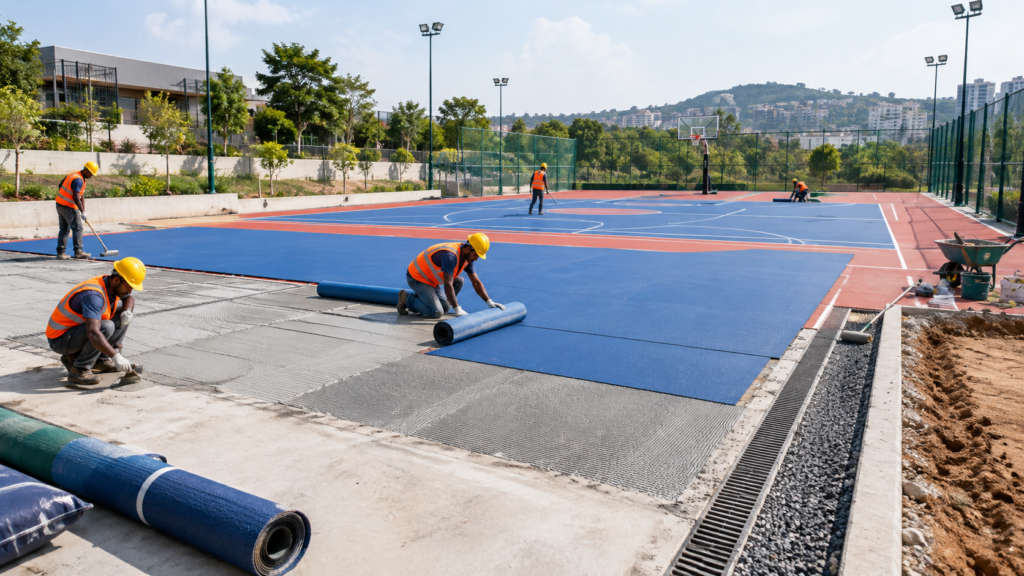
A sports court does not start with the flooring. A fair few things need to happen before the end surface can go down. Court size, ground conditions, drainage, base and floor condition, and line marking all contribute to the court’s feel and performance.
This applies to badminton, basketball, tennis, volleyball, and multipurpose courts. Things overlooked at the start can later show up as an uneven surface, water issues, wear and tear, or unnecessary repairs.
What Are the Main Stages of Sports Court Construction?
Sports court construction is done step by step. As many factors exist below the surface as above. Following these steps makes the process easier, and a strong base helps the final result perform as intended.
Site Assessment and Court Planning
First, observe the site and determine exactly how the court will be used. Consider space, sport type, indoor or outdoor use, player level, and anticipated traffic. Before construction, address court use, access, lighting, fencing, drainage, and surrounding space. For outdoor courts, also consider rain, weather, and water disposal.
Groundwork and Base Preparation
You can only install flooring on a court that is solid and level. This may include excavation, compaction, concrete or asphalt work, moisture control, and leveling, depending on the site. At this point, you need to correct any cracks, low spots, uneven areas, or drainage issues. If left as-is, they can cause trouble once you install the final sports surface.
Choosing the Right Sports Surface
No single sports surface works for every court. It depends on the sport and the court’s location. Indoor courts may use wooden, PVC, vinyl, or synthetic systems. Acrylic, PU, EPDM, or other weather-resistant flooring materials are common in outdoor courts. Consider several factors when choosing a suitable grip: grip, shock absorption, ball response, durability, maintenance, and relevant sports standards.
Installing the Flooring System
Installation is dependent on the material used. The wooden sports floor may require a vapour barrier, cushioning, timber runners, surface boards, sanding, and protective finishing. Asian Flooring describes this type of layered installation for its wooden sports flooring systems. Synthetic and acrylic courts may also need primer, cushioning, texture, and color layers, depending on the flooring system.
Court Marking and Final Finishing
Once the surface is ready, mark the game lines to the required dimensions. Then install posts, nets, hoops, and other equipment. Before anyone starts playing, check the court properly. The team should check the level, finish, grip, dimensions, and any visible defects and fix problems before handover.
What Should You Check Before Handing Over the Court?
Do not judge a finished court only by how it looks. Check the whole sports facility before handing it over for regular use.
- Performance and Safety
- Drainage and Moisture Control
- Maintenance Requirements
Conclusion
Creating a sports court is more than simply laying a beautiful floor. All the planning, preparation, base preparation, surface selection, installation, and final checks must be performed in concert. Each stage shapes how the finished court performs.
That is where Asian Flooring India steps in. In addition to supplying indoor and outdoor sports flooring, we provide court construction, installation, and maintenance services.
Our team can advise on the type of flooring and construction system best suited to a new court for schools, clubs, stadiums, universities, hotels, and other sports facilities, based on the sport, site conditions, and use.